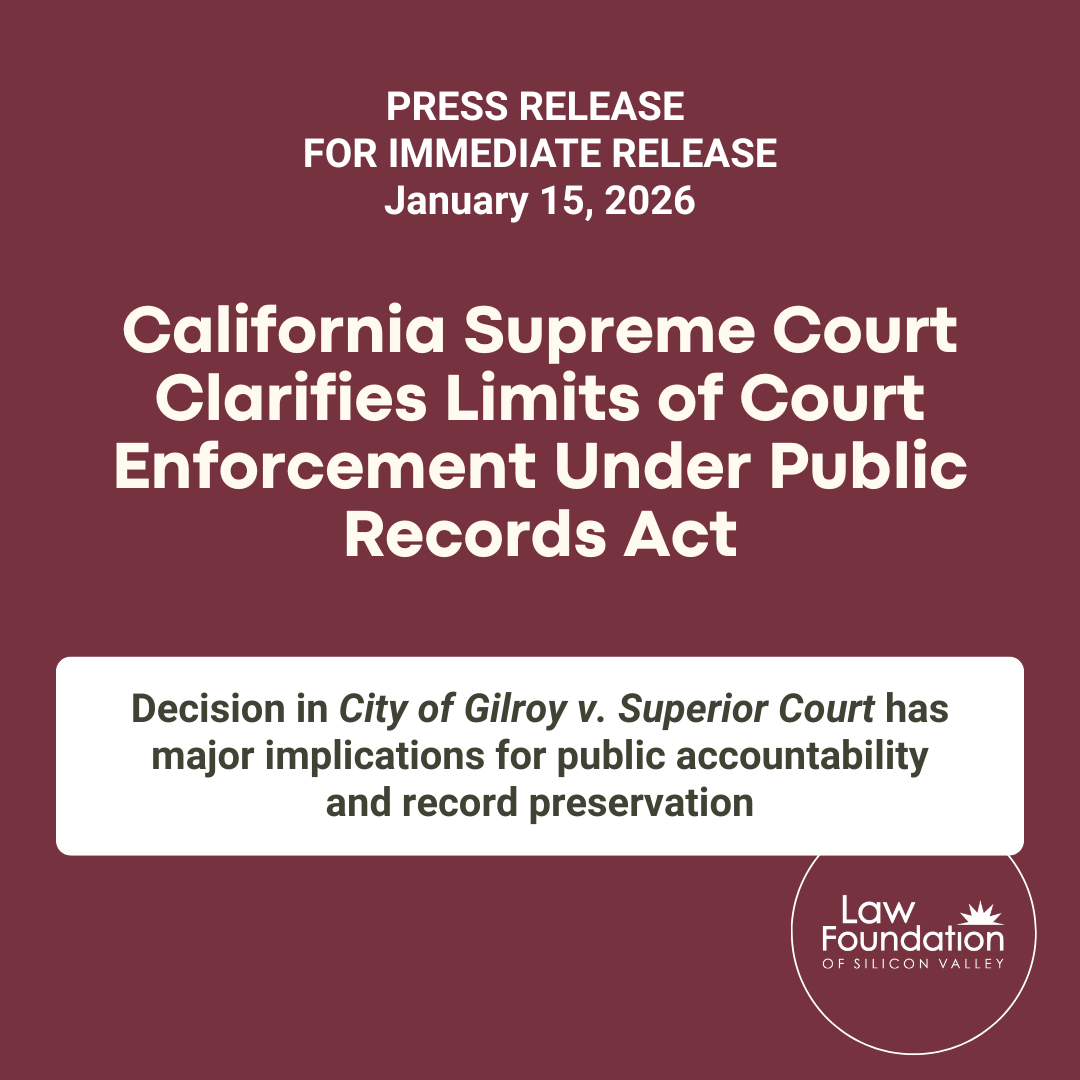
SAN JOSE, CA — The Law Foundation of Silicon Valley secured a landmark decision ensuring government agencies are held accountable when they improperly withhold materials essential to public accountability. The Supreme Court of California today published its decision in City of Gilroy v. Superior Court , a case addressing the people’s right to access public records under the California Public Records Act (CPRA). This case represents a significant victory for government transparency and accountability.
The case arises from public records requests related to sweeps of homeless encampments in the City of Gilroy, which resulted in the destruction of personal property. The requests sought Gilroy Police Department’s bodycam footage. Gilroy resisted disclosure of this information by asserting blanket objections, not being forthcoming on the records it had and then destroying the documents.
The Court ruled that declaratory relief is available to enforce the public’s right to public records, particularly when a court declaration would resolve a dispute about the parties’ rights and obligations that is likely to affect future governmental conduct. Stated more simply, the Court ruled that Courts can hold government agencies accountable for failure to provide important information even when the documents no longer exist.
“Government work is the people’s business. When it is carried out without visibility or oversight, vulnerable communities too often pay the price. This is apparent now more than ever. This decision is a big win for advocates seeking to protect the public interest,” said Alison Brunner, Esq., CEO of the Law Foundation of Silicon Valley.
Neel Chatterjee, a longtime member of the Law Foundation of Silicon Valley Board of Directors, argued the case before the Supreme Court as pro bono co-counsel with King & Spalding. He shared, “We are grateful that the Supreme Court found that government agencies cannot escape accountability simply because they destroyed the records. We are looking forward to the next stage of the litigation.”
“The Court’s decision strongly supports our ability to fully investigate government entities for instances of discrimination against the disability community,” shared Disability Rights Advocates attorney Thomas Zito.
The Law Foundation of Silicon Valley and its partners encourage lawmakers, advocates, and community members to work together to strengthen California’s public records laws and ensure meaningful accountability when government transparency is violated. The Supreme Court also found that duties to preserve documents during the pendency of a public records act request do not exist and that the duty to preserve must be created through a legislative solution.
The Law Foundation was represented by Disability Rights Advocates, King & Spalding, and Goodwin Procter and is grateful for their assistance in this groundbreaking matter.
ABOUT THE PARTNERS
Law Foundation of Silicon Valley: A nonprofit legal aid organization focused on housing, health, and children’s rights issues and advocacy.
Disability Rights Advocates: A nonprofit legal center dedicated to protecting and advancing the civil rights of people with disabilities nationally.
King & Spalding: An international law firm with 26 offices worldwide.
Goodwin Procter: A global law firm with 16 offices across North America, Europe, and Asia.
MEDIA CONTACTS
Law Foundation of Silicon Valley
communications@lawfoundation.org
Neel Chatterjee, King & Spalding
650-422-6708
nchatterjee@kslaw.com
Jessica Schnack, King & Spalding
jschnack@kslaw.com
Goodwin Procter
press@goodwinprocter.com
Thomas Zito, Disability Rights Advocates
tzito@dralegal.org